25 May 2026
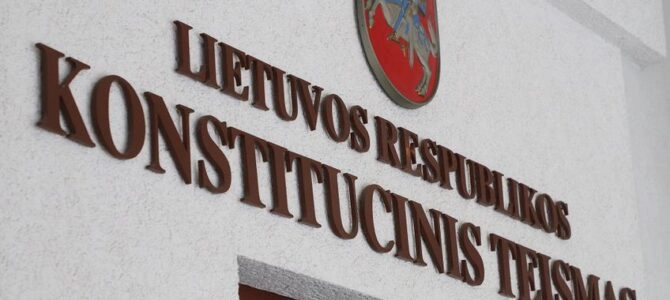
Member of the European Parliament and former Chairman of the Lithuanian Constitutional Court Dainius Žalimas published a response to our questions in which, instead of addressing them directly, he resorted to a well-known tactic: shifting attention to unrelated topics.
The questions we asked him were extremely specific. First, how were the EUR 200,000 received by his foundation and allocated for supporting democracy in Belarus actually used? Second, does he consider it acceptable to take money for “consulting services” from people who had gone through prison, torture, and abuse in Belarusian jails? Third, does he consider it moral to spend tens, perhaps even hundreds of thousands of euros allocated to support Belarusians on personal needs, while single mothers with young children who fled the country out of fear of persecution were literally struggling to survive and feed their children?
Žalimas’s first attempt at self-justification was almost amusing. He claimed that he had merely been a hired director and therefore had not kept the documents.
Hearing an argument about the “lack of responsibility” of a “hired director” from a former Chairman of the Constitutional Court is, to say the least, strange. Even Funt, the literary character from The Little Golden Calf, was more honest. When he accepted such positions, he fully understood that his sole role was to bear responsibility for other people’s schemes. “I am Funt,” he says, “I served under Alexander III, under Nicholas II, under the Provisional Government, under the Bolsheviks…”
Yet in trying to evade responsibility, Žalimas makes an extremely important admission. By portraying himself as merely a nominal figure, a fictitious manager, or a front man, he implicitly acknowledges that there were real decision-makers and actual controllers of the funds behind him. In that case, the “Center for Law and Democracy” may have been only one element of a broader system that managed to absorb around EUR 350 million allocated to support the Belarusian democratic movement.
Indeed, to process sums of that magnitude without leaving traces in a country where every liter of fuel is accounted for, there must have existed an entire system of mutual cover-up: “auditing” structures that conveniently “find no violations,” interested officials willing to approve such reports, as well as law enforcement bodies and courts refusing to examine any complaints related to possible abuses.
What exactly is Žalimas’s “professionalism”? The ability to divert attention to topics entirely unrelated to the questions asked. A classic card-sharper’s tactic: make unnecessary movements, create distractions, engage in meaningless chatter, and at the crucial moment substitute the card.
The first thing he did was accuse me of being “pro-Russian” — a label routinely used whenever someone wants to distract attention from the actual issue under discussion.
There is a well-known Cold War joke about democracy. An American says he can stand in front of the White House with a sign saying “Down with Reagan,” and nothing will happen to him. The Russian replies: “I can also stand on Red Square with a sign saying ‘Down with Reagan.’”
One does not need much courage to shout “Down with the American President” on Red Square. Yet somehow I seem to have missed whether Žalimas ever accused, for example, Gitanas Nausėda of being “pro-Russian,” despite the fact that he received a Communist Party membership card at a time when much of the Lithuanian intelligentsia had already begun the movement for independence.
Nor did I see Žalimas accuse members of his own government of being “pro-Russian” after sanctions against Belarus were introduced, when the transit of Belarusian and Russian oil products and potash fertilizers through Lithuania sharply increased, as reported by the Financial Times. Nor did he, as a Member of the European Parliament, raise questions about the “pro-Russian” nature of Lithuanian officials when Lithuania became one of the largest suppliers of wine to the Russian market, surpassing Italy, France, and Spain, or when it became one of the global leaders in exports of luxury cars to Russia.
Yet somehow he noticed my alleged “pro-Russianism.” Perhaps it lies in the fact that after challenging Lukashenko’s dictatorship, my house and apartment were destroyed and looted. First, the security services smashed windows, broke down doors, destroyed furniture to demonstrate to everyone — including our children — what happens to those who dare to seek power in Belarus. Later, all my property was auctioned off far below market value. Even children’s belongings, bicycles, and toys were sold off — see Charter97. And our family was far from the only one to lose everything.
Žalimas profited from this.
Or perhaps my “pro-Russian stance” consists in the fact that the Lukashenko regime sentenced me to 17 years in prison, while my wife, Veronica Tsepkalo, was sentenced to 12?
The Lithuanian politician accuses me of leaving for Europe through Russia. If he does not suffer from selective amnesia — as in the case of the documents of the foundation he headed — then he should remember that in 2020, due to COVID restrictions, EU borders were closed, and traveling through Russia to Ukraine and then onward to Europe was the only way to avoid arrest at the border. Although, of course, there were also “special” exceptions when certain individuals received not only safe escort directly to the Lithuanian border but also cash assistance.
Speaking of cash. As a lawyer, Žalimas could offer a legal assessment of the fact that Sviatlana Tsikhanouskaya received EUR 15,000 from security services and brought it into Lithuania without declaration — a fact that surfaced only five years later.
Security services do not simply hand out money for no reason. He could also assess whether the receipt of these funds was connected to the initiatives of the so-called “Tsikhanouskaya Office,” allegedly established by a Lithuanian citizen, which resulted in the mass arrests of hundreds of people in Belarus: the “Peramoga Plan,” the “Black Book of Belarus,” “Hajun,” and others, which significantly increased the number of political prisoners in Belarus.
Incidentally, these structures were objectively interested in such arrests, because the harsher the repression became, the more funding they received.
The accusations of my “marginality” are another familiar tactic — an ad hominem attack. Convenient because it requires neither facts nor arguments.
What exactly constitutes “marginality”? Was it my leadership of the Lithuanian-Belarusian and Latvian-Belarusian border delimitation and demarcation commissions, which enabled Lithuania and Latvia to sign border agreements and relatively quickly join the EU? Was it my co-chairmanship of the Belarusian-American Commission on Nuclear Disarmament together with U.S. Secretary of Defense William Perry? Or perhaps it was the creation of the largest IT cluster in Europe? Or my participation in the Belarusian presidential elections, where my team collected the second-highest number of signatures in the country’s history in support of my candidacy?
Still, Žalimas and those behind him cannot be denied foresight. They understood that I came to Lithuania to build a broad democratic movement based on the model of popular fronts that existed in many countries during periods of democratic transformation and struggles for independence; to create a political council with transparent participation criteria; to ensure collective discussion of received funds; and to establish an audit commission to oversee their use.
But transparency and accountability were precisely what the Lithuanian handlers of the newly manufactured “leader” feared most. As it later became clear, they wanted to use the money for personal enrichment. I was an inconvenient figure because I would never have allowed this.
That is why the lowest methods of pressure were chosen — pressure through two small children who at that time were only seven years old. During the period when Žalimas chaired the Constitutional Court and Landsbergis, “deeply involved in Belarusian affairs,” headed the Lithuanian Foreign Ministry, Lithuanian authorities decided to punish us and our children with enormous fines simply because, after arriving in Vilnius, we took the children to a café to feed them. To make matters worse, my wife Veronica’s driving license was confiscated. My appeals to Lithuanian courts were blocked on various invented grounds. The latest excuse was that I allegedly did not possess a Lithuanian electronic signature(!).
But sooner or later, the hidden becomes visible. And the fact that this process has already begun gives hope.
Hope that democratic values in Lithuania and Europe are not merely empty words. Hope that transparency, justice, and accountability can still be achieved. This is necessary not only for Belarus — to honor those who sacrificed themselves in the name of these principles — but for Lithuania as well.
Therefore, Dainius Žalimas, I address you publicly: if you are not afraid of an open discussion, if you truly have nothing to hide, let us debate these questions live on air.
Choose the channel. Choose the journalist — even one fully on your side. Let us discuss “pro-Russianism,” Crimea, responsibility for the war in Ukraine, and above all — who profited from the suffering, tragedy, and struggle of the Belarusian people.