26 March 2026
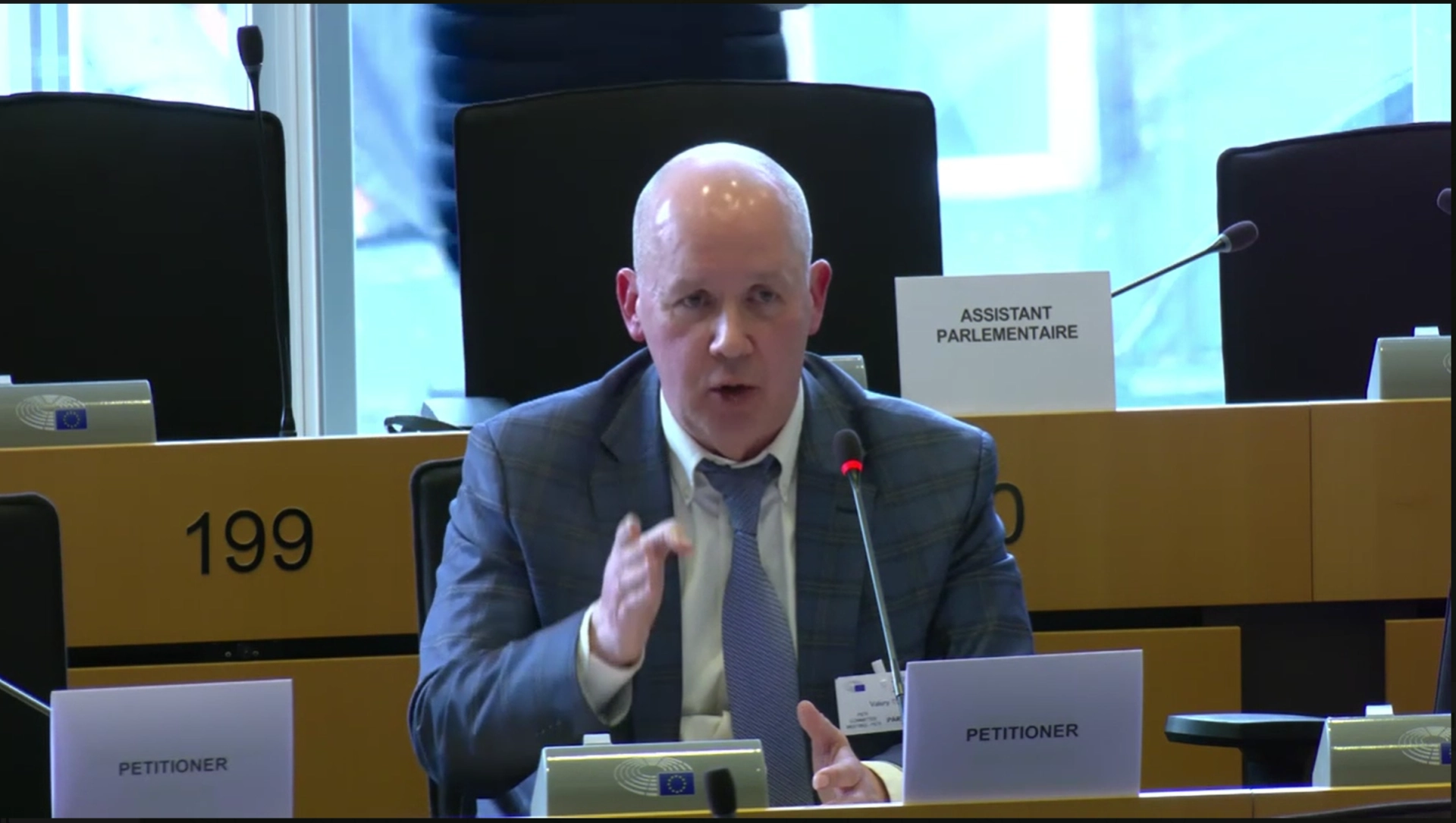
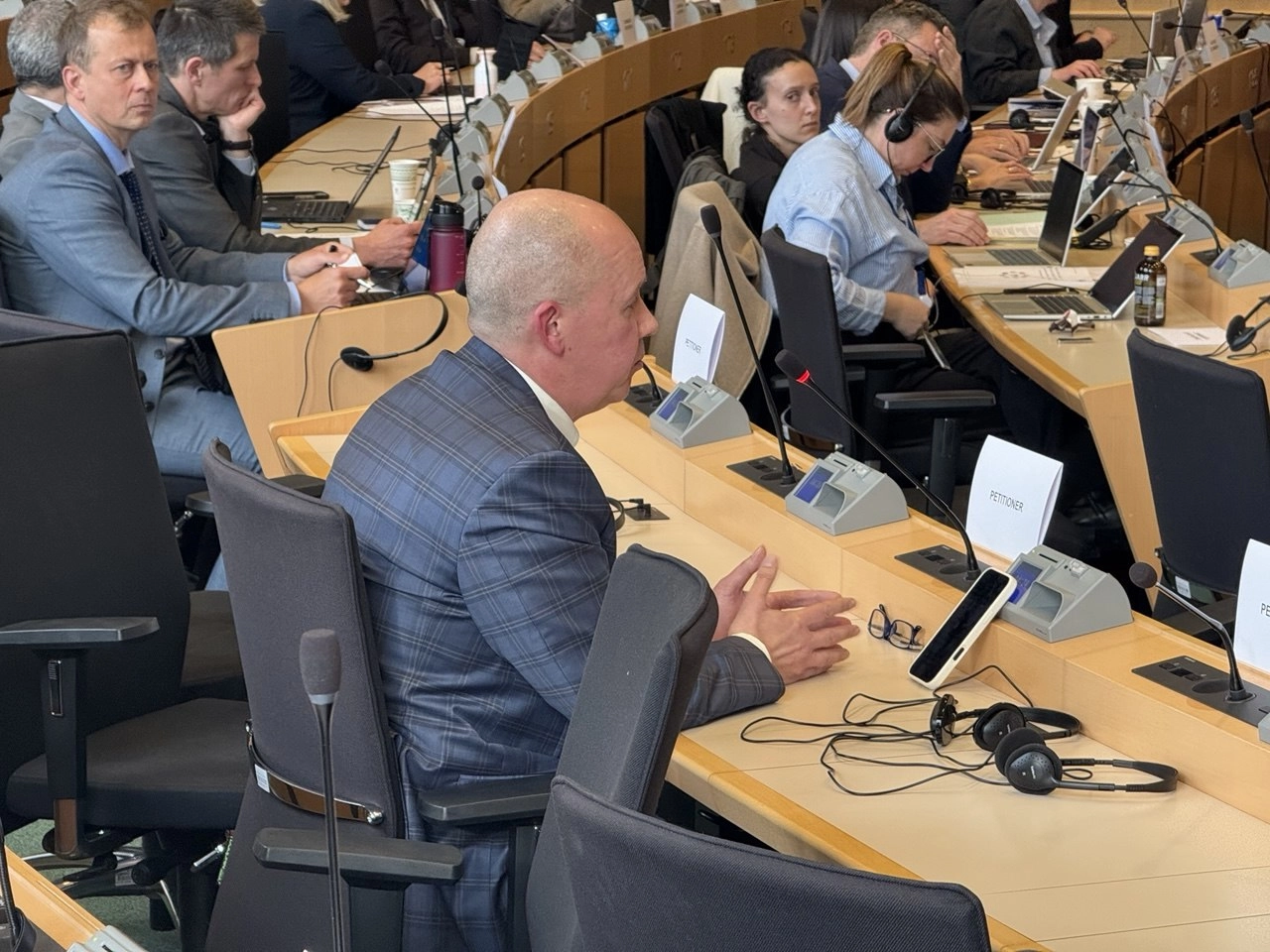
Madam Chair, Honourable Members of the European Parliament,
A petition is submitted for your consideration that touches upon one of the fundamental principles of the European Union — equality before the law.
Let me emphasize from the outset: this is not about the absence of European values. Europe has created one of the most advanced legal systems in the world. The issue is different — these values are being applied selectively, and therefore not to everyone.
Our petition concerns Raiffeisen Bank International — a financial institution that has effectively found itself outside the scope of real sanctions and regulatory enforcement.
For those of you who may not be familiar with Raiffeisen, let me clarify:
According to Forbes, Raiffeisen Bank International is among the three systemically important banks in Russia. It services around half, and in some sectors up to 60–70 percent, of the country’s foreign trade turnover.
This point deserves special emphasis. More than half of Russia’s foreign trade is not handled by Chinese, American, Singaporean, or Indian banks. It is handled by a bank from a country that is a member of the European Union.
Raiffeisen’s profits in Russia exceed the combined profits of all its 12 European subsidiaries, including its parent bank in Austria. Over four years since the start of the war in Ukraine, the Austrian bank has paid nearly $2 billion in taxes to the Russian budget. Its profit on the Russian market in 2025 alone amounted to approximately €1 billion.
These figures are particularly telling against the backdrop of discussions about yet another, already the twentieth, sanctions package by the European Commission against Russia and Belarus, in which there is no place for one of the three main financial institutions of Russia.
Why is this happening? Why are some subject to sanctions, deprived of property, having their personal accounts frozen, while others, such as Strobl and Hameseder, continue to profit from the monopolistic position of the financial institution they lead? Why are some punished, while others are allowed to prosper?
I raised this question with the Commissioner for Financial Services, Maria Luís Albuquerque, in May last year at a roundtable organized on the occasion of awarding the Charlemagne Prize to Ursula von der Leyen — which, for the first time in its 75-year history, was accompanied by a monetary award exceeding €1 million. The sponsor of the prize was German Raiffeisen.
The response referred to the need to preserve humanitarian channels, primarily for food supplies to prevent hunger and for medicines to prevent epidemics.
However, as it turns out, there is no mass hunger in Russia. On the contrary, Russia actively exports grain — primarily wheat, barley, and corn — as well as fish, poultry, and rapeseed, making it one of the world’s leading food exporters.
Nor are there any outbreaks of epidemics. Russia not only supplies itself with antibiotics and other medicines, but also exports them abroad — albeit in smaller volumes compared to food.
Raiffeisen was not selected through any open, transparent, or competitive procedure. Yet even outside formal public procurement frameworks, EU law requires adherence to fundamental principles of equal treatment, non-discrimination, and transparency, as reflected in Articles 18, 101, and 102 of the Treaty on the Functioning of the European Union (TFEU), as well as established case law of the Court of Justice of the EU.
Moreover, its activities go far beyond humanitarian operations. Through this bank pass transactions involving energy resources, industrial equipment, microelectronics, and components potentially used in the military industry.
And this, Honourable Members, is deeply concerning. Because when a humanitarian argument is used to justify commercial activity, it is no longer humanitarian activity. It is a cover for circumventing sanctions.
Honourable Members,
Europe has built one of the strongest legal systems in the world. But its strength lies not in the number of directives, regulations, or sanctions packages. It lies in one fundamental principle — the equal and predictable application of the law to all without exception. A selective approach undermines the very foundation of this system.
When one bank is effectively exempted from restrictions while all others face sanctions for comparable actions, sanctions policy loses its legal nature. It ceases to be a tool for upholding international law and becomes a mechanism for market redistribution and the extraction of excess profits.
There is no third option here: either sanctions are lifted, or they are applied equally to all — without privileges and without exceptions.
In the latter case, sanctions must also be imposed on Raiffeisen, on the same basis as on other participants in the Russian financial system. In addition, personal restrictions must be introduced against its leadership, including Johann Strobl and Erwin Hameseder, applying the same measures already imposed on Latvian citizen Petr Aven and Israeli citizen Mikhail Fridman — namely, asset freezes and travel restrictions. Notably, Aven and Fridman stepped down from Alfa-Bank management already in 2022, unlike Strobl and Hameseder.
Let us now turn to Belarus.
Raiffeisen claims to have exited the Belarusian market. But that is precisely the point — it is only claimed.
Initially, losses were estimated at €300 million. Two months later, this figure rose to €800 million. This is not just a significant discrepancy. For a public company, even a 10–20% deviation requires explanation; 30% becomes a matter for auditors and regulators. Here we see a change approaching 300%.
This goes far beyond market volatility. Such discrepancies, under European and international standards, require full transparency: what changed, why it changed, and how the new valuation was calculated.
But no such transparency exists.
Moreover, a key element of any transaction — its price — has not been disclosed. The Belarusian asset had been consistently reflected in the group’s consolidated reporting. That is, operations were transparent — the exit was not.
The buyer is a company created just two years before the transaction. Its beneficiary is an individual whose declared income as an employee is clearly disproportionate to the acquisition of one of the largest banks in Belarus. This does not merely raise questions — it requires verification of the origin of funds and the structure of the transaction.
And yet, we see a complete lack of response from European supervisory authorities.
In such a configuration, only two explanations are possible: either regulators failed to see the obvious, or chose not to see it. In both cases, this undermines trust in the supervisory system.
Because taken together, this is not merely a non-transparent transaction. It contains indications of a possible simulated market exit while retaining economic interest or control, or the transfer of assets to individuals linked to the Lukashenko family — which would constitute a direct circumvention of the sanctions regime.
At that point, the issue goes far beyond a single bank. It concerns the very ability of the European legal system to enforce its own rules.
What we see in the case of Raiffeisen is not only unfair to the thousands of companies that left the Russian market on moral grounds or were subjected to sanctions. It is dangerous.
Because a two-tier system is emerging in Europe: one for those who must comply with the law, and another for those who, possessing influence and resources, can continue to benefit from the situation.
This sends a deeply troubling signal, and not only within Europe. It sends a signal to authoritarian regimes, which can now confidently tell their citizens and businesses:
“You accuse us of nepotism, favoritism, opaque tenders, and corruption. But look at Europe. They also declare equality — yet in practice, there are those who are ‘more equal than others’. There are rules, but they do not apply to everyone.”
At that moment, Europe loses the moral authority to demand from others what it is not prepared to ensure within itself. Because double standards are the strongest justification for any injustice.
For this reason, Honourable Members, I ask you to support our petition.