26 March 2026
My visit to Washington has concluded. It was exceptionally intense, so much so that I was not able to speak about many of the meetings in real time.

President of Senate Chuck Grassley
This was partly due to lack of time and partly by design, so as not to jeopardize ongoing efforts to secure the release of political prisoners. I will share a fuller account of the trip later, when it becomes possible to do so.
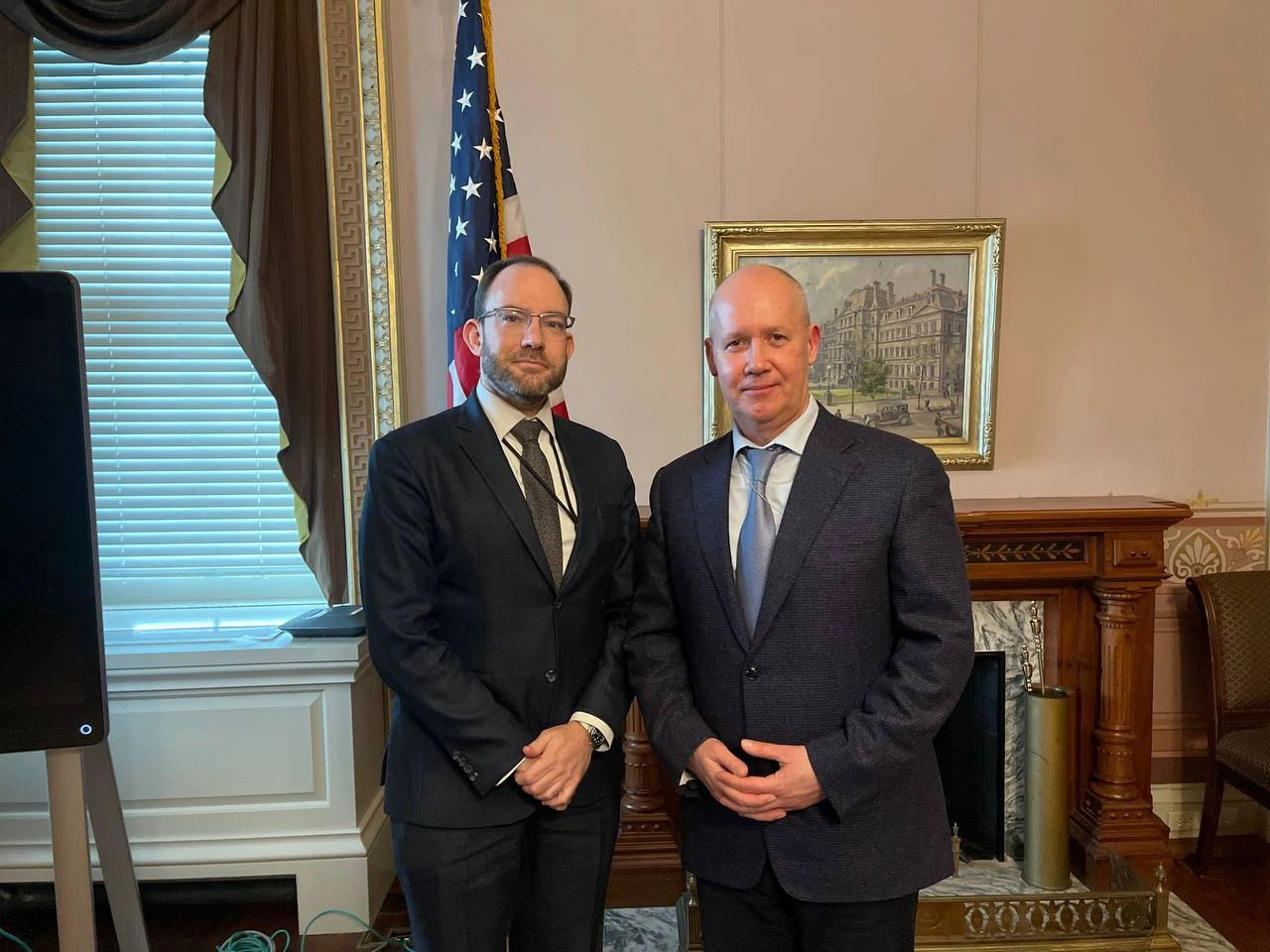
Andrew Baker, National Security Advisor
In addition to meetings at the White House, the National Security Council, and the US Department of State, where I unexpectedly met my longtime acquaintance John Armstrong, now serving as Principal Deputy Assistant Secretary for Consular Affairs, we held substantive discussions at the Atlantic Council, the National Democratic Institute, and the Center for Strategic and International Studies, institutions I have engaged with repeatedly over the years.

Charles Mc Laughlin IV, special assistant to the US President
It was at CSIS that I once met Zbigniew Brzezinski, then serving there as Senior Fellow. After the publication of my essay The Remaking of Eurasia in Foreign Affairs, he wrote to me personally. In that essay I proposed an alternative vision to his for engagement among post Soviet states.
Its essence was the following. The West, and above all the United States, should have supported post Soviet integration, including within the framework of the CIS, where I previously served as Senior Adviser, organizing meetings of heads of state, governments, and foreign ministers. Such a model could have helped prevent Yugoslavia style conflicts by reducing the geopolitical centrality of borders and by enabling the free movement of people.
The former Comecon countries, particularly Slovakia, Hungary, Romania, Bulgaria, and Poland, while gradually integrating into European structures, could simultaneously have acted as advocates for the post Soviet republics within the EU. Integrating into Europe while preserving historical ties with their eastern neighbors, they might have helped shape a single European space from the Atlantic to the Pacific and facilitated Russia’s inclusion in a broader European context.
Otherwise, I warned at the time, the post Soviet space would face conflicts among republics, with the inevitable involvement of external actors such as Turkey and Iran, since administrative borders often ignored ethnic and religious realities and therefore contained significant latent tensions. These conflicts by their nature could not remain local and would inevitably acquire a broader regional and international dimension.
Other key actors, including the United States, the United Kingdom, and Germany, would also not remain on the sidelines. Their involvement through security frameworks, alliance commitments, and their own strategic interests in Eurasia would inevitably increase tensions in their own interstate relations as well.
Unfortunately, many of these forecasts proved prescient. At the time, however, expectations of the end of history, as Francis Fukuyama famously described it, dominated the intellectual climate, along with confidence in the inevitable triumph of the liberal model. Zbigniew Brzezinski, who held a different geopolitical view from mine, was nevertheless intrigued by my argument that Russia was drifting toward a corrupt oligarchic system, a trend I had recognized years before it became evident to the broader policy community.