16 March 2026
If we understand evolution as the natural selection of those best adapted to survive, the human being appears as the product of “evolutionary failures.” We are not the fastest, not the most agile, and far from the strongest. Predators possess fangs and claws; most mammals are protected by fur or thick skin. The gorilla, one of humanity’s closest evolutionary relatives among the primates, surpasses us many times over in muscular strength.
The large human brain requires enormous energy expenditure, consuming about a fifth of the body’s total energy. This makes hunger an especially severe challenge and forces constant concern with securing food. Human childhood is unusually long, and the newborn is helpless to a degree rarely found in nature. Upright posture altered the structure of the pelvis, making childbirth more complicated, riskier, and far more painful, limiting reproductive capacity compared with other species.
And yet it is precisely the human being who has reached the top of the biological pyramid. Language gave us the ability to think abstractly, to discuss the future, and to transmit complex meaning. Difficult childbirth and prolonged childhood made child care not a private matter but a shared responsibility, strengthening emotional bonds within the group and anchoring survival in cooperation.
Human collectivity went beyond instinct. Not blind submission to a dominant male, but conscious deliberation and collective problem-solving became our evolutionary advantage. The ability to negotiate, distribute roles, and make decisions based on shared understanding allowed humans to act intentionally rather than merely react to changing circumstances.
It was the collective — more precisely, the thinking collective — that compensated for humanity’s physical “deficiency” and made it the dominant species.
The primitive group ensured not only protection and food gathering. It became a mechanism of memory. Knowledge of hunting grounds, plant properties, and seasonal cycles did not disappear with individuals but accumulated within the collective. This made the group more than simply capable of survival. Accumulated experience enabled adaptation to new environments, migration across vast distances, and gradual expansion across the entire planet.
The tribe distributed roles, forming the beginnings of specialization. It established norms, turning isolated decisions into rules and rules into tradition. A ban on hunting during breeding seasons may have begun as resource preservation. A prohibition on marriage within a clan may have arisen from observation of unhealthy offspring. Over time, such practical constraints took on the form of taboos. What once proved useful for survival became sacred.
With the rise of religion, social norms became spiritual laws, and belonging to a group became a condition of salvation. As the founder of Christianity proclaimed, “Where two or three are gathered in My name, there am I among them.”
Participation in church life or belonging to the ummah meant more than the possibility of salvation. It was, above all, a form of social solidarity and communal protection. The collective became a system of mutual responsibility and support in which faith strengthened not only the bond between the individual and God but also the bonds among people.
Aristotle called the human being a political animal, emphasizing our fundamental dependence on the polis as the space of shared life, where individuals realize themselves through participation in collective action, decision-making, and the formation of norms and rules.
The bond between the individual and the collective was so deep that even the greatest minds did not imagine themselves outside it. Socrates, condemned by the Athenian court, could have chosen exile instead of death. He refused. For him, separation from the polis meant the loss of identity itself.
Modernity
The modern era did not begin with spiritual revelations or revolutionary slogans. It began with the emergence of new forms of collectivity. These forms transformed the architecture of society.
First in trade, where the English and Dutch East India Companies became early examples of large-scale collective organization of capital. Then in production, where joint-stock companies allowed the pooling of resources, the distribution of risk, and the concentration of capital in projects beyond the reach of any single merchant or artisan.
A decisive turning point was the emergence of limited liability companies. They freed entrepreneurs from the threat of total personal ruin and opened the door to more ambitious risk-taking. Failure no longer meant debt bondage, as in antiquity, or imprisonment, as in certain medieval periods. Economic risk became institutionalized and limited. Business ceased to be an act of personal courage and became a system capable of outliving the individual.
These new forms enabled the transition from the private workshop to the manufactory, and from there to the factory and industrial plant. Production ceased to be a matter of individual craftsmanship and became a coordinated system based on division of labor, capital management, and organizational discipline.
New economic forms were followed by new forms of public self-organization. In eighteenth-century Europe, political clubs, Masonic lodges, discussion societies, and salons emerged as arenas for debate on representation, freedom, and sovereignty. The French Revolution did not begin with the storming of the Bastille. It was preceded by clubs, committees, and a National Assembly capable of channeling mass energy into political action.
The Continental Congress provided the platform where the North American colonies first acted as a coordinated whole. The Declaration of Independence, adopted on July 4, 1776, became a collective manifesto, legitimized through shared authorship and voting.
Political parties gradually emerged as stable mechanisms for mobilizing collective will. The party translated economic and social collectivities into political form. The Russian Revolution demonstrated that a disciplined party structure, grounded in collective decision-making, could both seize power and maintain it under civil war and external pressure.
Similar processes unfolded in science. An alchemist might work in isolation, propose hypotheses, and conduct experiments, but his discoveries often remained speculative or even fraudulent. Knowledge became power, as Francis Bacon proclaimed, only when it passed through public criticism and collective verification.
The founding of the Royal Society in London and the Paris Academy of Sciences institutionalized this transformation. Science left the realm of private revelation and became an institutional process. Truth came to mean what could withstand the test of collective reason, reproducibility, and open debate.
Human history is, in essence, the history of increasingly complex forms of collectivity. Progress did not occur because more talented individuals appeared, but because society developed ever more effective ways to unite them.
First came clan and tribe, forms of survival based on kinship and shared memory. Then religious communities that bound people not only by origin but by shared belief and moral law. The collective ceased to be merely a mechanism of protection and became a bearer of meaning.
The industrial era gave collectivity organizational form. Parties, trade unions, scientific academies, universities, and joint-stock companies emerged. People were united not by blood or faith alone, but by stable structures capable of coordinating the efforts of thousands and millions. It was this growing complexity of collective forms that made economic growth, scientific breakthroughs, and political transformation possible.
Yet for the first time in history, a new question arises: what happens if future development is no longer tied to the increasing complexity of collective forms? What if the very necessity of collectivity as the central principle of human existence disappears?
The Disappearance of Collectivity
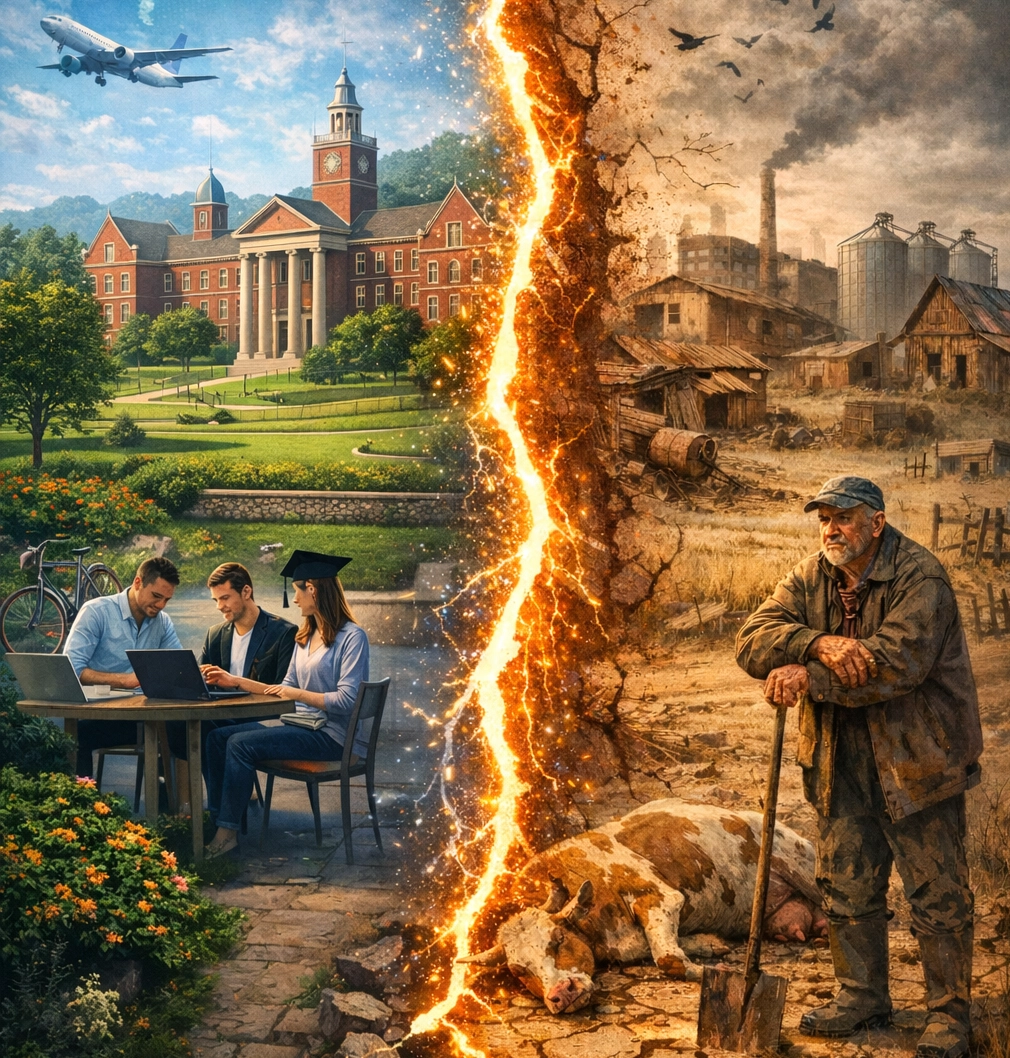
If the history of civilization has been the history of refining forms of interaction among people, the digital age marked the first weakening of the bond between the individual and the collective. The factory, the party, the university presupposed shared presence, regular interaction, and inclusion in a common space, whether a workshop floor, office building, or lecture hall.
Social networks shattered geographic enclosure. On the one hand, they expanded the collective, allowing communities to exist beyond territorial boundaries. Individuals could participate in collective life without physical proximity. They could discuss, coordinate, support, and even mobilize from anywhere.
Leaving a real-world collective is difficult. Even after departure, one continues to encounter others in the city, at work, in shops. These encounters create psychological pressure, sustaining systems of expectations and obligations. Physical presence makes collectivity stable and almost unavoidable.
A virtual community can be left with a single click. It creates no spatial pressure, requires less discipline and less responsibility. One can disappear from digital space without explanation and without the social consequences inevitable in offline life.
Yet this weakening did not mean the disappearance of collectivity itself. Social networks preserved the principle of association but made it less dense, less stable, less binding. People continue to group around interests, ideas, projects, opinion leaders, and intellectual centers. The space of communication shifted from the assembly hall to the screen; discussion became a continuous stream rather than shared presence.
Throughout civilization, the human being existed within the collective as part of a decision-making mechanism. Truth was formed within collectives: in science through verification, in parliament through debate and voting, in editorial offices through discussion, in corporations through coordination among departments.
A Fundamental Break
With the emergence of artificial intelligence, the situation changes fundamentally. What once required coordination among multiple departments can now be modeled by an algorithm. What was debated in meetings appears instantly on a smartphone screen.
Marketing programs, financial forecasts, logistical schemes, and investment strategies can be calculated without collective deliberation. Cultural preferences are increasingly shaped by algorithmic recommendation systems. Even this text, which once I would have discussed with an expert community, is in many respects created in dialogue with artificial intelligence.
At this moment, the human being is removed from the previous organizational and cognitive dependence on the group. The collective ceases to be necessary for work, analysis, strategic planning, choice, and orientation in the world.
If the digital age made the collective fluid, the age of artificial intelligence calls into question its necessity altogether. Here lies the true break: the collective ceases to be a required condition for the production of truth and effective action. The human being is moved beyond society, because the collective ceases to be not only a condition of survival but of effective business, scientific inquiry, and even thought itself.
The collective ceases to be the bearer of reason.
Does this mean that the very nature of the human being as a rational creature is now under threat?