14 April 2026
This year, the prestigious Charlemagne Prize in Germany was awarded to Mario Draghi, former Prime Minister of Italy, former President of the European Central Bank, and one of the key figures in European economic policymaking over the past decade. A year earlier, he presented a comprehensive report on the future of Europe’s competitiveness, unveiled with considerable ceremony alongside Ursula von der Leyen, last year’s recipient of the same award.
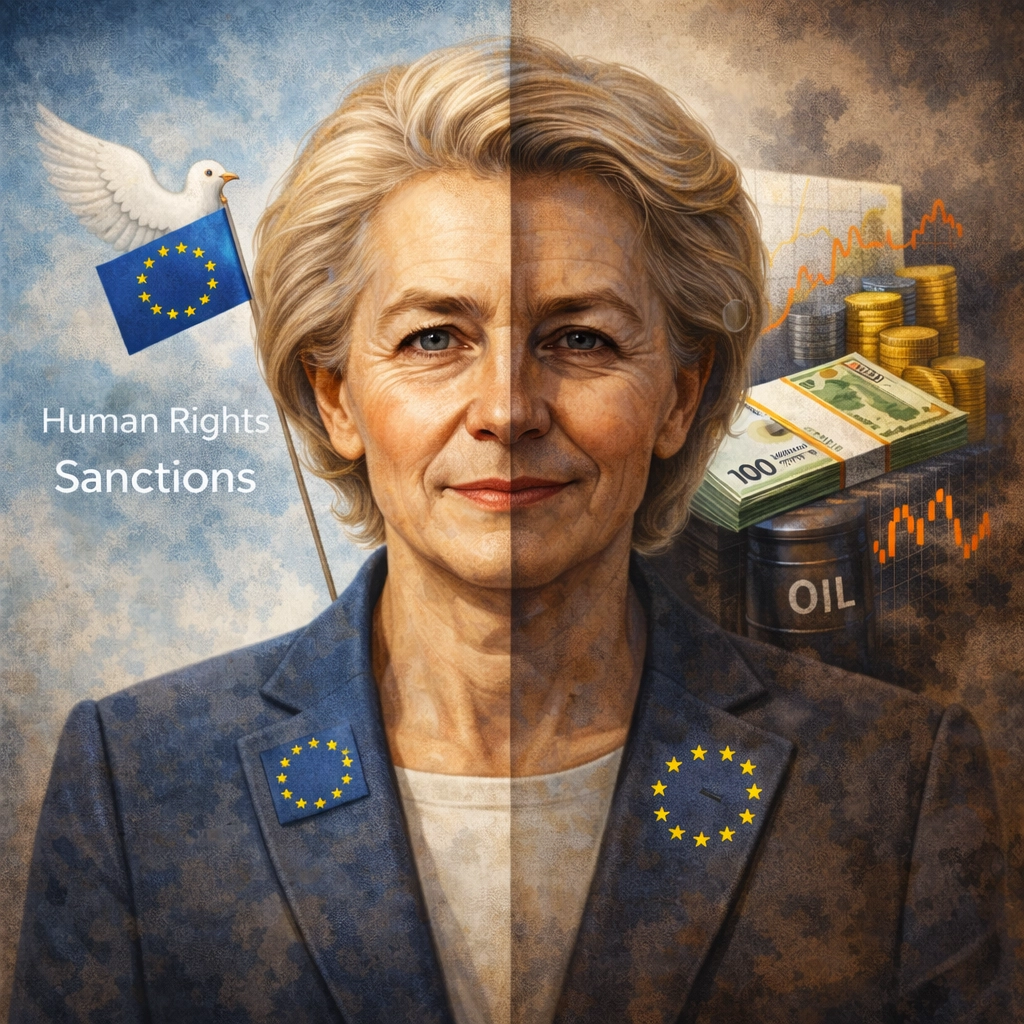
Notably, for the first time in the 75-year history of the Charlemagne Prize, it was accompanied by a substantial financial component exceeding one million euros. The source of funding was hardly surprising: Raiffeisen Bank served as the monetary sponsor. Despite the EU’s sanctions regime, the bank continues to occupy a distinct and privileged position in both the Russian and European markets. Following the outbreak of the war in Ukraine, its Russian subsidiary facilitated up to half of Russia’s foreign trade transactions, serviced clients linked to the supply of equipment and chemical components for the military industry, and was involved in projects related to the confiscation of property from political opponents in Belarus (Bloomberg).
However, that is not the focus here. Draghi’s report itself, which at the time of its release—like for many others—escaped my attention, deserves a far more careful and critical reading. It is a lengthy document (over 75 pages), overloaded with obvious statements, statistical data, and the typical language of European bureaucracy, through which one must push rather forcefully to extract substantive meaning.
That said, we should not approach this report through the prism of the Belarusian experience. A country where, in the 21st century, state-level discussions revolve around compost production, fertilizers, and the prevention of mass livestock deaths in collective farm facilities has long fallen out of the substantive international agenda, appearing primarily in the context of human trafficking—that is, political hostages.
The issues currently framed as “economic policy” in Belarus ceased to concern Europe as far back as the 19th century, when the continent was debating industrialization, railway construction, mass urbanization, the formation of a global financial system based on the gold standard, the choice between free trade and protectionism, and the creation of the first institutions of the welfare state.
Today, the Belarusian experience exists more as a historical paradox in which the past not only returns but appears intellectually ahead of the present. This is no longer a subject for economic analysis, but rather one for literary or artistic reflection.
It therefore makes more sense to assess the report through the lens of global competitiveness. The world is already structured around major centers of power. The United States sets the agenda through technological leadership and entrepreneurial freedom. China offers scale, state-driven strategy, and long-term predictability. Asia is advancing rapidly, and Latin America is catching up. Against this backdrop, Europe attempts to define itself through a set of measures and regulatory instruments.
What stands out immediately is the absence of a central idea. Not in the sense of individual initiatives, but of a broader purpose capable of setting direction. The document identifies problems, lists barriers, and proposes adjustments, yet it fails to answer the key question: where exactly does Europe intend to go, and why should people follow?
The report also contains practical omissions. It speaks of technology but overlooks the economics of digital ecosystems, an area in which Europe is largely absent. It refers to innovation but pays little attention to access to data as a critical resource for artificial intelligence. While identifying institutional constraints, it says nothing about transforming the culture of risk and entrepreneurship. It operates at the level of states and the EU, yet barely considers cities as real engines of growth, nor does it address the conditions needed to attract a globally mobile class of professionals. Finally, it entirely ignores alternative financial systems and their potential role in the emerging economic landscape.
Despite these limitations, the report’s main contribution lies in its ability to frame the problem. It acknowledges Europe’s growing lag and attempts to bring competitiveness back to the center of the European agenda. In this sense, its function is diagnostic rather than strategic.
But diagnosis alone does not change trajectory. Europe has long been capable of describing its problems. What it struggles with is answering a far more difficult question: what vision of the future it is prepared to offer—to the world and to itself.
Let us now examine this gap more closely.